Showing posts with label film. Show all posts

Wednesday, July 25, 2012

The Amazing Spider-Man (2012)


(Writer's note: Back from the dead. This thing has been resurrected more times than Lazarus. Had some motivation last night,and here's what came from it)

Oh, mild spoilers ahead. Read at own caution)


I think it would be an understatement to say that I am a huge Spider-Man fan.

My future. Source: Wikipedia.
He’s probably my favourite comic book hero (next to Batman). I’ve read the comics (I have reprints of Amazing Fantasy #15 and Spider-Man #50), grew up with the 90’s animated series, and saw the movies in theatres (Spider-Man 2 was a family movie night and some of the most fun I’ve had at the theatre). Heck, it’s a running gag among my family that I will end up as J. Jonah Jameson, demanding pictures of Spider-Man.


I could relate a lot to Parker in the comics. A regular guy, given powers, not sure what to do with them; He struggled to pay the rent. His social life was lacking. He didn’t get any respect from the media. But, he still soldiered on. Great message. I love Batman, but I can’t relate to Bruce Wayne. He has unlimited money, access to great equipment and a cool car. He’s wish-fulfillment, escapism.


Like most people, I watched the Sam Raimi movies and thought that Spider-Man 3 was lousy, especially coming off the greatness of Spider-Man 2. Too many plots, an unnecessary retcon, misuse of Venom and that goddamn dance scene in the middle. And Spider-Man 4 sounded worse in the planning stages (I sound biased, but early plans were to have the Vulture as the villain, and Anne Hathaway playing his daughter The Vultress. Even as a kid, I always found the Vulture a lame villain. A man in a bird suit is not a villain; it’s a mid-life crisis). Raimi and Sony butted heads over the direction of the project, and eventually Raimi left. Tobey Maguire and Kirsten Dunst followed suit. Sony then announced plans to hire a new director and reboot the series from the beginning, to keep the movie rights from reverting back to Marvel.


Reboot. One of the two dirty R words in modern day Hollywood (remake is the other one). It has become a symbol of the lack of creativity that people complain about in movies these days. Considering that this reboot would be released five years after Spider-Man 3, many people were not looking forward to it, me included. But, hey, open mind and whatnot.
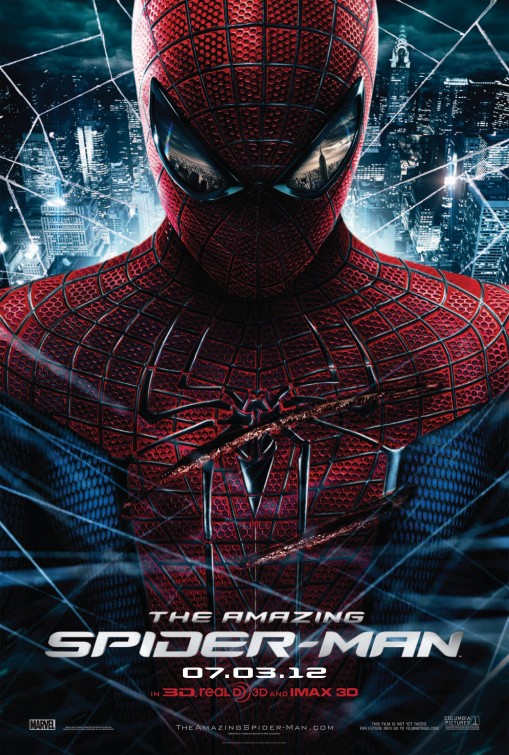


Sony owns the rights to this poster.
I went to see The Amazing Spider-Man about a week ago and left the theatre impressed. Although there were flaws, I felt that it was an interesting take on the character and actually better than the original Spider-Man film released in 2002.


Andrew Garfield (The Social Network) portrays Peter Parker, raised by his Aunt May and Uncle Ben (Sally Field and Martin Sheen) after his parents mysteriously die when he was a kid.  Although intelligent, Peter is a loner at high school and a target for bullies. He harbours a crush on Gwen Stacy (Emma Stone), a popular student who shares a similar passion for science, working as an intern at OsCorp for Dr. Curt Connors (Rhys Ifans). Connors worked with Peter’s father, and it is on a trip to OsCorp to see Connors that he gets bitten by a genetically engineer spider which causes many changes to him.


The biggest flaw in the movie we have to sit through the origin story again. If you asked someone how Peter Parker became Spider-Man, they could probably tell you exactly how it happened. Have a little respect for the audience Hollywood. Also, this version brings in Peter’s parents, has them die at the beginning, but then kind of drops it halfway through the movie (though in a post-credits scene, it is brought up again). However, the movie does pick-up significantly after the spider-bite, and several of the origin points were handled better in this version, such as Uncle Ben’s death.


I liked Garfield’s take on Peter Parker, portraying him as a socially-awkward loner but with a little bit of an edge present. It’s a more realistic (as realistic as you can get with a comic book character) and modern interpretation of Spider-Man. And once he gets the costume, he moves far ahead of Tobey. As far as I’m concerned, Garfield is Spider-Man. The main reason: his wit. Tobey was humourless. Garfield actually cracked jokes in the costume like Spider-Man would in the comics.


As for other performances, Emma Stone as Gwen Stacy was a highlight of the film, portraying a strong love-interest who is not a damsel-in-distress like other comic characters. She has tremendous chemistry with Garfield, which adds to their scenes together. Ifans’ portrayal of Connors and his villainous alter-ego The Lizard was also a strong performance. He’s not a true villain, just a guy who makes the wrong choice. However, Denis Leary, in his small screen-time, nearly stole the show as Gwen’s father George, a police captain who does not approve of Spider-Man methods. It is in fact, his scene with Peter at dinner that helps set him on the path to being a hero.


The theme of responsibility is one of the key themes of Spider-Man (I think we can all recite the famous phrase from the comics) and I liked how the movie handles it with Parker. The entire movie, even before he gets his powers, builds to him accepting responsibility for his actions as both Parker and Spider-Man.


The action in the movie, performed with a lot of wire-work, was also better than the 2002 movie, which has not aged well visually. During Spider-man’s fights with the Lizard, it feels like watching one of the comics come to life with the way he moves and dodges attacks, throwing in his webs for good measure.


In addition, this movie features the best Stan Lee cameo in a Marvel movie.


The Amazing Spider-Man was a better movie than it had any right to be, considering the reasons for it being made. Despite a retelling of the origin story, the movie picks up significantly from there, with strong performances and action keeping it from becoming a cynical, mediocre cash-in, like many feared it would be. I hope that the sequel adds to the strong foundation that this movie built.

Saturday, April 23, 2011

Movie Watching Habits/Theater Pet Peeves

I have a few rules for when I watch movies at home.

-The lights have to be off. If I watch a movie during the day, I find that there is too much of a glare on the screen. I try to draw curtains, but it doesn’t always work. So, I have to wait for the evening. Besides, a movie affects you differently depending on the time you watch it. For example, Lost in Translation, as I mentioned in my review, needs to be experienced at night.
-I always finish the movie, no matter how terrible it is. I've done it at home before, but no longer anymore. I can also proudly say that I have never walked out of a movie, though Step Brothers really tested my patience.
-My rule for movies on television is this: if the movie has already started, I will not watch it. I need to watch a movie from the beginning, especially if I haven't seen it before. The exception to the rule is if I have seen the movie a few times before, and need something on in the background on a Sunday afternoon. Forrest Gump and Gladiator are usually the go to movies for these occasions.

-I do not like watching movies on my laptop. Movies were meant to be experienced on a large screen and with Dolby Surround Sound, not through crappy speakers and a tiny screen. Besides, there are too many distractions on a computer, like Facebook or a blog.

-Audio commentaries are a mixed bag. Some commentaries are interesting and you learn interesting facts about the movies. Others are just awkward self-congratulation fests. But, I always check them out. some really good ones include Citizen Kane (commentated on by Roger Ebert), This is Spinal Tap (cast does it all in character), and The Lord of the Rings (There are commentaries by the cast, crew, and set designers).

-Everybody must remain quiet. Some talking is okay, but don’t talk throughout the entire movie. This leads me to…


My pet peeves at the movie theatres:

-Talking. The main reason I rarely go to the theatres anymore. I can’t stand it when people talk throughout the movie, either telling someone what’s going on, or trying to be witty and make snarky comments throughout the movie. You’re not as witty as you like to think you are.

-Cellphone use: I hate the glowing blue screen from the phone of some teenager or adult that flashes every few minutes. Turn your phone off. You can wait two hours before sending a message to that person.

-Parents taking young children to inappropriate films: This is common among newer parents; they’re stressed and they want a night out, but can’t find someone to babysit their child. So they take their toddler to the movie they want to see, usually an action film of some sort. Baby starts crying, it annoys the entire theatre, and then they end up leaving. What they need to learn is that a baby is a major responsibility, and sometimes you have to cut out things that you enjoy because of you child if you can’t find a baby sitter. Rent a movie.

Experienced parents are just as guilty of this. When Watchmen came out, I went to see it in theatres, and a mother with three young children, no older than ten, sat down a few rows in front of me. She likely assumed that since it involved superheroes, it must be for kids. Watchmen is a hard R rated film, and it was clearly advertised in the trailers. I believe after witnessing the violent opening scene, an attempted rape, and a naked blue guy, she and her kids walked out of theatre, wasting at least $50. Parents need to research the movies that their kids want to see, and there are all sorts of websites online that will tell parents the content of the film. Don’t assume that just because it looks kid friendly (superheroes, talking CGI creatures, animated) that it is appropriate for children. I’m reminded of numerous staff room conversations about the first time some teachers watched Family Guy.

-Price gouging: It’s getting out of control at this point, especially at the snack bar. A common scenario: you at the movies on Friday night by yourself (usually what I do; my taste in movies is a lot different from my friends) and you pay ten dollars for a ticket. Not great, but that is the way things are going these days. You head to the snack bar, and by the time you buy a popcorn and drink, you are out another ten dollars. And it gets worse if you have a family, or are out on a date. The snack bar is the biggest ripoff at the theatre these days, and the popcorn isn't even as good as it used to be.

3D movies are another price gouger. Theatres will add an extra few dollars in the ticket price for the glasses, and still charge you even if you bring your pair from another movie to the theatre. I could write a blog ranting about 3D. Maybe the next blog.

That is a list of my habits/pet peeves when watching movies. What are yours?

Sunday, February 27, 2011

Academy Awards 2010

This year, I don't think people can complain about The Academy nominating movies that the majority of the public hasn't heard of, let alone watched. Out of the ten nominated films:


  • Toy Story 3 and Inception were two of the highest grossing films in 2010. (Toy Story 3 was first, Inception was fourth).

  • Black Swan, True Grit and The King's Speech made over $100 million at the box office. This is impressive, considering they are three genres that studio's assume the public won't watch (Art-house, Western, and Drama).

  • The Social Network and The Fighter finished outside the $100 million total, but still had strong box office performance (approximately $97 million and $89 million, respectively) and widespread critical acclaim.

  • Even the other three nominated movies (127 Hours, The Kids Are All Right, and Winter's Bone) despite grossing less than the other films, still managed to turn a profit considering their budgets.

All things considered, 70% is pretty good for the Academy Awards.

As for my predictions,  I'm personally hoping that The Social Network wins Best Picture, but won't be surprised if The King's Speech takes it. It has everything that the Academy loves: it's a historical drama focused on the British monarchy;  it is promoted by the Weinstein Company, who specialize in this type of film (ex. Shakespeare in Love);it is largely inoffensive, with the exception of that one scene where King George VI says fuck 5 times;  It has the story of a person overcoming adversity or a disability. (stuttering). All it needed was the Holocaust, and Best Picture wouldn't even be a contest.

Despite my prediction of Best Picture, I see David Fincher winning Best Director for The Social Network as his direction was why a movie about Facebook was so successful. Still can't believe Christopher Nolan was snubbed for Inception. I would have nominated Nolan over  David O. Russell (The Fighter). 

Most of the Acting categories are locks. Natalie Portman for Black Swan and Colin Firth for The King's Speech will take the lead acting oscar's. Christian Bale will finally be rewarded for his work, winning Best Supporting Actor for The Fighter. Bale will also win because the Academy will need some younger faces to be nominated in the future, now that Russell Crowe and Denzel Washington are older and entering the "Paycheque" phase of their career. Supporting Actress is the tightest race. I think Melissa Leo will not win for The Fighter for two reasons. 1) Her co-star Amy Adams is nominated, so they'll split the vote. and 2) Her solo For Your consideration campaign may have ruined her chances. Either Hailee Steinfeld (True Grit) or Helena Bonham Carter (The King's Speech) will win this award, but I'm leaning toward Carter.

Gwenyth Paltrow wins best song because Hollywood is intent on forcing the idea of her as a singer on the public.

Final note: How surreal would it be if Trent Reznor won an Academy Award?

Thursday, April 22, 2010

Prom Night In Mississippi (2009)

Authors note: I started writing this review on April 10. I was anticipating it being finished by the next day. But, as it often is, the best laid plans of mice and men often go arwy. I finished half of the review, but was unable to finish the other half until about five minutes ago. My real life got in the way, and I have been busy. My goal is to become more regular with this blog in the coming months.
Also, I'm not really happy with the way this review is written. I do not feel that it is my best work. But check it out anyway, and tell me what you think. Now that I've gotten that message out of the way, (and everyone has likely stopped reading by now), on with the review:


I’m a fan of documentaries. They are always interesting to watch, shedding light on interesting people and events. I also watch documentaries that bring important issues to the forefront of the Western consciousness, that call for changes in the way our society acts. Prom Night in Mississippi, directed by Paul Saltzman, falls into the latter category, with a story of discrimination that is sadly still common today.

I watched the documentary this week after reading the latest news story about Constance McMillen. McMillen, for those who haven’t been paying attention, went to the administration of the Itawamba County School District asking permission to take her girlfriend to the senior prom and to wear a tuxedo. How does this school district in 2010 respond? By canceling the prom and trying to blame McMillian for it. After rightfully getting sued by the ACLU for this, the school reinstates the regular prom, but organizes a private prom for the rest of the student body, presumably so they don’t have to be in the same room as a same-sex couple. Total number of students attending the school sponsored prom: seven. The theme of separate proms runs both in the film and this recent news story, showing that some places in America still have a long way to go before equality for all can be achieved.

Charleston, Mississippi was one of the last places in America to desegregate high schools (this happened in 1970). But, one of the last things that remained segregated was the senior prom. The schools would hold a prom for both black and white students. In 1997, Morgan Freeman, a resident of Charleston, heard about this, and spoke out against these proms. He even made the school board an offer – he’d pay for the prom if they integrated it. He was turned down. Students started to pressure the school board, and finally, in 2008, the school accepted Freeman’s offer.

The documentary looks at the struggles that people had in making the integrated prom a reality. The school and students have to deal with pressure from certain groups of parents and students, who don’t want the prom to go on. Some students, who were speaking out against the racism, were interviewed in shadow, obviously worried about the potential harm that could happen to them if their identity was public. Many of the students were open to the idea of the prom. It was the parents that were against it. A group of white parents even held a whites-only prom in private, similar to what happened in the McMillan case. Saltzman is unable to film inside the white-prom, but finds a creative way around it. Whenever Saltzman can’t film an event, the film will shift in art style. He will have a person relate what happened, and show the events in stylized comic form. It is a creative idea for a documentary filmmaker to use in order to work around the limitations he may encounter.

There is one really interesting story in the film, concerning the interracial couple at the prom. The film interviews the father of the white girl, who is going to the prom with her black boyfriend. The father admits that he is prejudiced, and he has problems with his prejudice, but he will do anything for his daughter. It is powerful stuff, and gives the documentary an emotional centre.
At the end, the prom goes well. Prom Night in Mississippi was an interesting film, and very eye-opening. It shows that we still have a long way to go for true equality to happen, but we see that each passing generation is making changes, and doing their best to make bigotry a thing of the past. But, work still needs to be done to ensure that everyone, regardless of race, gender, or sexual orientation, are able to receive the same rights that the majority of the population has.

Sunday, March 28, 2010

Lost In Translation (2003)


First thing I'll say: This is an awesome poster. I wish that there was a way to get a print of this poster that wouldn't set me back $100. Not to knock the other poster, which is awesome and can be viewed here, I just prefer this one. It's colorful, eye catching , and lets face it, Scarlett is a little easier on the eyes that Bill Murray in a bathrobe.


I remember wanting to see this film when I was fifteen. I was wanting to develop a more sophisticated taste in films that my peers, and I was also interested in the art of cinema. I ended up buying the movie when it was released on DVD, and I watched it in the afternoon when I got home.


I shut it off after 20 minutes. My God it was boring. Time to go back to the populist movies that everyone liked. Fuck the Academy.


I held onto the DVD for some reason. I don't know why. Maybe fate. so, flash forward to my summer as a sixteen year old. We didn't have air-conditioning installed in my house yet, and the heat made it unbearable to sleep in my room. So, I did what I always did whenever it was too hot; I took my pillow and blanket and camped out on the couch in my basement. I still couldn't sleep, so I decided to put a movie on, and I noticed Lost in Translation on the shelf. I grabbed it and put it on, knowing that I'd be asleep in 20 minutes.


It didn't happen.


I stayed up late at night, totally engrossed in the movie. I don't know why I did; maybe my tastes matured, maybe the film is better at night. I don't know. I fell asleep at night with pleasant dreams of Tokyo and Scarlett Johanssen. This movie kick started my interest in the country of Japan and my crush on Scarlett Johanssen, but everybody knows that already.


Enough about my personal bullshit, I'm going to talk about the movie. Lost In Translation is about two people in Japan. Bob Harris (Bill Murray) is an American actor getting paid $2 million to appear in a Suntory Whiskey commercial. Bob is very much washed up, doing the commercial for the money, when he "really wants to be doing a play somewhere." His marriage is lacking communication; his wife sends him carpet samples and faxes him to let him know he forgot his son's birthday. Charlotte (Johanssen) is 25 years old, a philosophy graduate from Yale, who is tagging along with her photographer husband (Giovanni Ribsi). Charlotte is wondering about her purpose in life, and whether or not her marriage was the right thing to do. Bob and Charlotte meet by chance at the hotel bar, and a friendship develops. They decide to make the most of their time together in Tokyo, hanging out and having adventures around the city.
Most of the humor that occurs in the film is based around the culture shock of Japan. One example During the commercial shoot, Bob is getting instructions in Japanese from the director in Japanese (and his instructions are not subtitled, so unless you speak Japanese, you are as lost as Bob is), and he gets a pithy translation. Here is the exchange:
Director [in Japanese, to Bob]: Mr. Bob. You are sitting quietly in your study. And then there is a bottle of Suntory whiskey on top of the table. You understand, right? With wholehearted feeling, slowly, look at the camera, tenderly, and as if you are meeting old friends, say the words. As if you are Bogie in Casablanca, saying, "Here's looking at you, kid," -- Suntory time!
Interpreter [In English, to Bob]: He wants you to turn, look in camera. O.K.?
(beat)
Bob: Is that all he said?


Director and Screenwriter Sofia Coppola made very wise choices with this film. She never once falls into the romantic movie cliches. Bob and Charlotte's relationship is very much platonic. Sex between the two of them never comes up (it would be gross, considering Scarlett was only 18 when this movie was made). It is a relationship of understanding, of similar circumstances, and a connection that you may only make once in your life. The film deals more with concepts such as loneliness and relationships, and not being where you want to be in your life.


This is the role that Bill Murray will be remembered for. It was written with him in mind, according to Coppola. There is a lot of subtlety to his performance. He could very easily turn on his charm and crack jokes for the entire crew in Japan, but his body language suggests that he is tired and not willing to be Bob Harris, Hollywood star and life of the party anymore. Bob Harris was written with Bill Murray in mind, and Coppola has gone on record saying if he didn't sign on, she would not have made the film. Scarlett, at 18, does a great job exploring the nuances of being young and unsure of yourself. I think the phrase "wise beyond their years" is such a cliche, but it is appropriate here to describe her performance. Ribsi is in a supporting role, along with Anna Faris as a ditzy Hollywood actress, but they are both superb in the small amount of screentime they're given. Supposedly, they are based on Spike Jonze, Coppola's ex husband, and Cameron Diaz, though Coppola denies this.


Two more things help make this film enjoyable. First, the cinematography is absolutely stunning. It gives Tokyo a real dream like quality, especially at night. Secondly, the soundtrack, consisting of shoegaze artists like Death in Vegas, The Jesus and Mary Chain, and Kevin Shields, also adds to the dreamy effect, allowing the viewer to get lost in the movie.


Lost In Translation is one of those movies that needs to be watched in multiple sittings in order to appreciate it. It takes a while for it to unfold, but it is worth it in the end. It is one of those films that works best when watched alone, allowing you to think about life and what you want from it. If I recommend one film that everyone should watch, this it the one.